

Become More Demanding
What being Demanding means
The undemanding reader asks no questions-and gets no answers.
Mortimer J. Adler, Charles Van Doren - How to Read a Book: The Classic Guide to Intelligent Reading
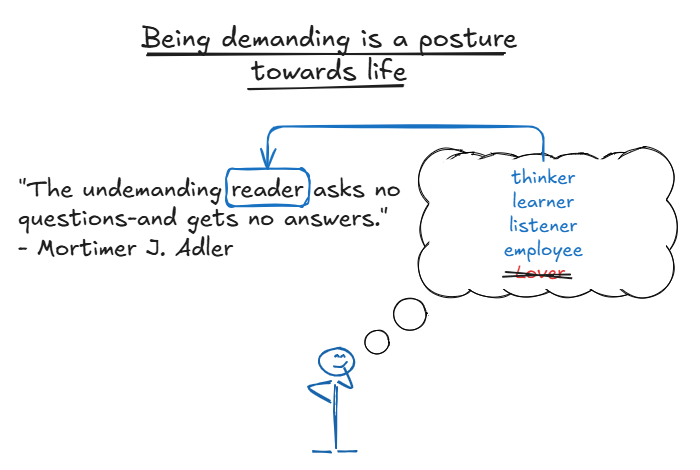
A demanding person tends to manufacture dissatisfaction with reality as it presently appears to them. They do not simply accept what is given. They create a higher-order tension between themselves and the world: this is wrong, confusing, ugly, insufficient, or not yet understood. But that tension moves them into action because, at some level, they want to resolve it. Even if the process feels like irritation, anger, or annoyance, there is still something attractive in it to them. They are drawn to the work of correction.
A demanding person, then, does not merely notice problems. They actively produce a felt sense that there is a problem here. That produced dissatisfaction is the tension. The tension is higher order because it targets not just what is there but how it is framed, what is taken for granted, and what has been quietly settled without examination. It is the wedge they drive between themselves and the apparent shape of things.
To be demanding, in this sense, is to refuse the first appearance of adequacy. They like to think it is to make the world answerable to deeper standards of understanding, coherence, truth, or form. A demanding person treats reality not as something to passively accommodate, but as something to question, press against, and improve.
Being demanding, then, is the attitude of making the world feel like a problem on purpose, because only a world that feels problematic invites improved understanding and better action. The demanding person lives by creating these tensions and then trying to resolve them.
So how do you become more demanding?
"How do I become more demanding" can easily become a project of adopting the behaviors of demanding people which are asking more questions, pushing back more, complaining about frames, refusing to settle. But doing those things without the underlying engine just produces contrarianism or fussiness. The behaviors are downstream of something.
What's upstream is the belief that the gap between appearance and reality matters, is closeable, and is worth the discomfort of opening. Without that belief, no amount of behavioral imitation produces the real thing. So the question isn't really "what should I do" but it's "what would I have to believe, care about, and tolerate for demandingness to become my natural posture?"
Start from things you already care about enough to be dissatisfied about
Manufactured dissatisfaction needs a seed. The seed is usually a domain where you already feel a faint wrongness that you've been discharging through acceptance, dismissal, or distraction. Pick one and refuse to discharge it. Sit with the wrongness until it becomes articulable. The muscle you're building is tolerance for unresolved tension which is the actual bottleneck for most people, not insight.
Treat your own reactions as data rather than verdicts
When you feel confused, irritated, bored, or vaguely dissatisfied, that's information about a gap between your model and the situation. Most people close the gap by suppressing the reaction. The demanding move is to hold the reaction open and ask what it's pointing at. The reaction itself is often more accurate than the official story being told around it.
Become suspicious of settledness
When something feels closed, examined, handled, consensus treat that as a flag, not a conclusion. Not because settledness is always wrong, but because it's the thing that most reliably hides problems. Ask yourself who decided this was settled? What would have to be true for them to be wrong? What's the strongest case that the frame itself is off?
Work on hard-to-vary explanations of your own, not just criticisms of other's
This is the piece that separates demandingness from contrarianism. If you're going to refuse what's there, you have to be building something that could fail. Otherwise the refusing becomes the whole activity and you never get to the resolution.
Protect the enjoyment
This is the part most advice misses. If the tension becomes only painful, you'll stop. The demanding person finds something in the friction *attractive*. It could be the sense that the world is alive to them, that there's work to do, that they're in real contact with what is. If you're losing that, you've drifted into grinding, and the attitude won't sustain. Notice what kinds of problems light you up and what kinds only exhaust you.
Spend time around people who already have it, and let it friction your own standards
Demandingness is partly contagious. The Bell Labs effect in Hamming's telling isn't mystical, it's that proximity to people with higher standards makes your own apparent adequacy visible as inadequate. You start to manufacture dissatisfaction almost involuntarily because your baseline for "fine" has shifted.
Resist the failure modes
The main ones: manufacturing tension about things you can't or won't actually work on (this becomes cynicism), making the tension about other people rather than reality (this becomes contempt), demanding from others what you don't demand from yourself (this becomes tyranny), and refusing to ever resolve tension because resolution feels like settling (this becomes paralysis). The attitude only works if it stays pointed at soluble problems, generates internal work, and closes loops when they're closable.
See also:
Paul Graham's Taste for Makers
Edsger Dijkstra's essay On the Cruelty of Really Teaching Computer Science
C. Wright Mills's On Intellectual Craftsmanship
Richard Hamming's You and Your Research
Links to this note:
Don't Protect Your Ideas