

Freewill & The Power to Change Reality
Status: surviving, 13 May 2026
Problem: What moves the boundary of what you can do?
Two stories about agency dominate the conversation, and both are wrong.
The first says agency is a skill. You build it through reps — taking initiative, making decisions, exercising discipline. The advice is to grind: do hard things, build the muscle, become more agentic over time. Variants of this story dress it up as virtue, as habit-formation, as productivity, as character. The shape stays the same.
The second says agency is a trait. Some people have it, some don't. It's a function of personality, of neurochemistry, of upbringing, of class. The advice — if there is any — is to accept your lot, or maybe wait for circumstances to change. Variants of this story locate the source in genes, in dopamine, in structural conditions. The shape stays the same.
The two camps argue with each other. Neither notices they share the same mistake.
The Shared Error
Both stories treat agency as a substance — something that exists in or accumulates within a person. The skill view says you build up more of the substance through practice. The trait view says you're issued a fixed amount at birth or by circumstance. They disagree about the source. They agree about the shape.
The shape is wrong.
If agency were a substance, someone with a lot of it should be able to deploy it on any problem. They can't. The most disciplined person in the world can grind for a decade inside a frame that has no exit and stay exactly where they started. If agency were a substance, someone with little of it should be unable to break out. But the breakout cases — the person who suddenly sees an option nobody else saw — happen constantly, and they happen to people who, on the substance view, shouldn't have it.
Both stories predict the wrong things, and the wrong things keep happening. That's the cue to stop refining the stories and look for a different object.
What's Actually Happening
Here's a different proposal: agency is not the fundamental thing. It's a surface manifestation of a deeper capacity — the ability to create explanatory knowledge that expands the space of available actions.
Three sources shape what a person can do. Biology — what your genes equip you for. Culture — the memes you've absorbed, the scripts you've inherited. And explanatory knowledge — the understandings you've created about what is there, what it does, and how and why. The first two write the script. The third lets you rewrite it.
The question isn't "how much agency do you have." The question is "are you creating explanations?" If yes, the space of what you can actually do is growing. If no, you're playing whatever script the first two sources handed you, however well or poorly.
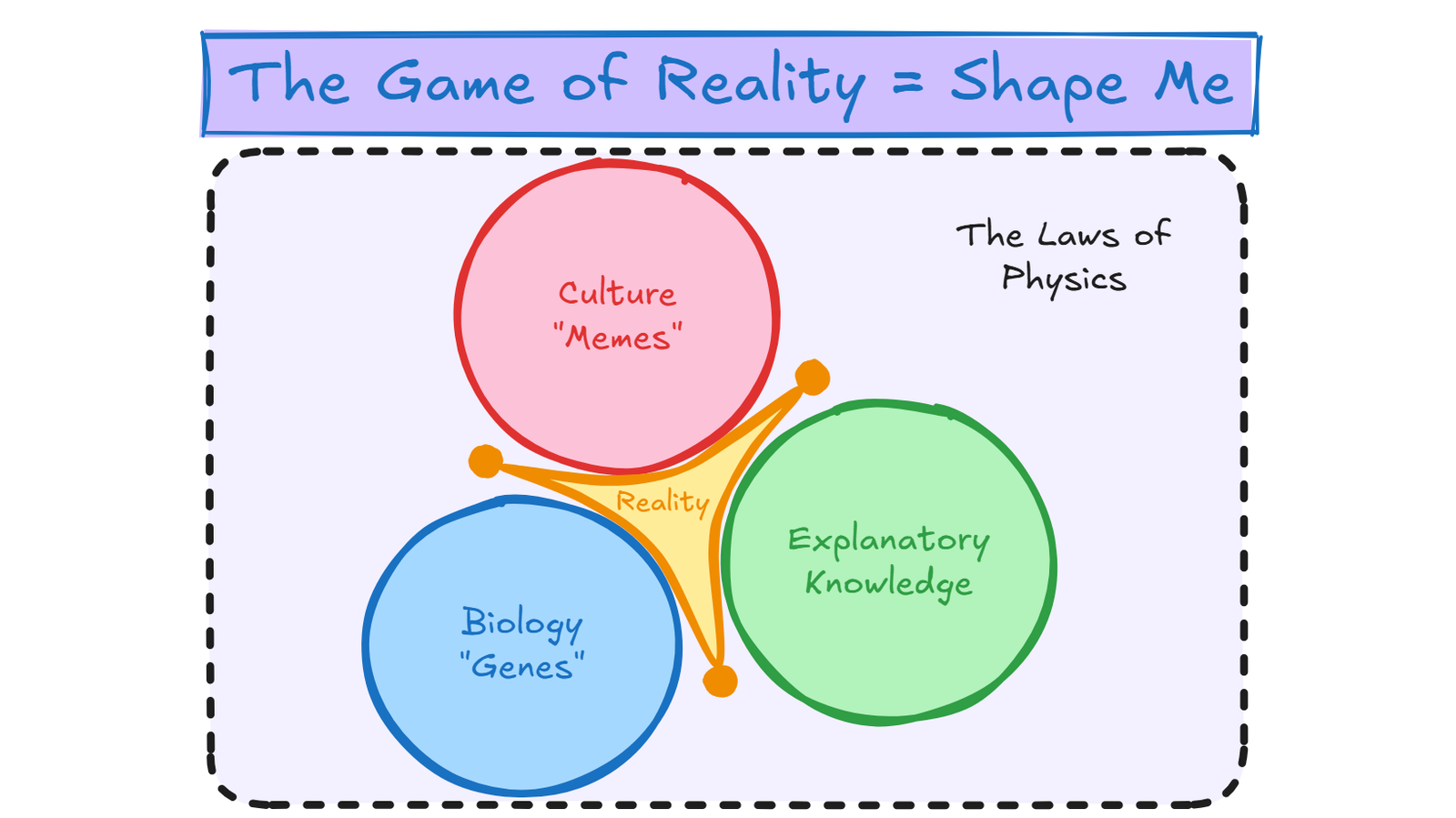
Available vs Possible
The critical distinction is between possible actions and available actions.
Possible actions are everything physics permits. Most of that space is enormous and irrelevant to your life. Available actions are the actions you can actually take right now, from where you are, given what you understand. Available is a tiny subset of possible.
The gap between them is not a physics problem. It's an explanation problem.
Before you understood compound interest, "let a small sum grow into a large one over decades" wasn't on your menu. Physics permitted it the whole time. You couldn't choose it, because you couldn't see it. Before anyone understood antibiotics, "cure a bacterial infection" wasn't available to any human anywhere. Physics permitted it. The action did not enter the available space until the explanation existed.
Every available action is gated by an explanation. Every new explanation moves the gate.
The Move That Matters
Stated precisely:
In plain language: an agent A at time t with knowledge state \(K_t\) has the capacity to act — what's usually called free will — if and only if there is some explanation \(E\), not yet in \(K_t\), that A could create, such that adding \(E\) to \(K_t\) enlarges the choice space \(C(K_t)\) into a strictly larger choice space \(C(K_t ∪ {E})\), still bounded by what physics allows.
Since humans are the kind of thing that creates explanations, this is essentially always true. The capacity is structural. Whether you exercise it is a different question.
What expands the available space is not effort, not talent, not initiative. It is the creation of explanation. An explanation, here, isn't a description or a label — it's a hard-to-vary account of what's there and why, one where every detail does work and you can say exactly what would refute it. Soft accounts don't open anything; they rephrase the existing space. Real explanations move the boundary.
The boundary moves into the adjacent possible. You can't jump to arbitrary points in physics-space. You can only reach what becomes adjacent given what you now understand. Each explanation opens its own neighborhood. Stay in one place and the neighborhood is fixed. Create, and it grows.
What This Commits Us To
If agency is downstream of knowledge creation, four things follow, and each is a way the claim could be wrong.
No knowledge creation, no expansion. A person executing a known script brilliantly is not expanding their action space, however impressive the execution. A person fumbling toward a new explanation is, however clumsy the attempt.
Real explanation, real expansion. You cannot create a genuine explanation and leave your option set unchanged. If "understanding" something leaves your available actions identical, you've memorized or rehearsed — you haven't explained.
Reach scales with the depth of the explanation, not the effort behind it. One good explanation that reframes a problem opens more ground than a decade of work inside the existing frame.
The capacity is universal in principle. The person who looks like a non-player character is not a different kind of being. They are a universal explainer not currently explaining.
If any of these turn out to be false, the thesis is in trouble. That is how it should be.
Why This Matters
The skill view tells you to grind harder inside the frame. The trait view tells you to accept the frame. Both keep the frame fixed and ask what you'll do inside it.
The frame is not fixed. It's made of explanations, and explanations can be created. What looks like agency from the outside is what creating explanations looks like from the outside. You don't get more of it by trying to be more agentic. You get there by doing the underlying thing — building accounts of reality precise enough to be wrong, and seeing what opens up when they survive.
The space of available actions is not a property of the world. It's a function of what you understand about the world. Change the understanding, and the world you can actually act in changes with it.